Researchers develop low-cost portable sensor to detect deadly microorganisms in drinking water
Posted on Thursday 8 August 2024
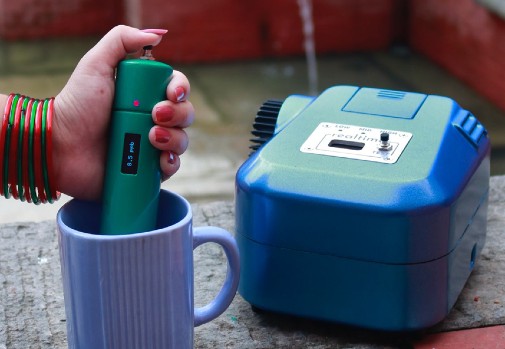
The team behind the project - a collaboration between the University of York and researchers from Phutung Research Institute, Nepal and University of Sao Paolo, Brazil - say the device has the potential to be widely deployed in low and middle income countries and provides an effective and low-cost solution for monitoring water quality and preventing waterborne diseases.
Organisations like UNICEF have for some time been seeking solutions for innovative and easy to use water testing methods to determine faecal contamination.
Easy to use
Researchers say the device - named realtimeWAS (for water assessment system) - is inexpensive to manufacture, portable, easy to use and designed for use by the general public with little training.
The device, which is the size of a sandwich box, is capable of detecting fluorescent proteins that indicate bacteria concentrations as low as required for drinking water.
The research team say such a system can meet WHO criteria to detect deadly microorganisms in drinking water - which claims almost one million lives every year in developing countries.
Support
The project was made possible thanks to the support and backing of the University of York and Professor Thomas Krauss’ research group.
When the initial funding from the UK Global Challengers Research Fund was terminated, the University of York stepped in and supported the project, which culminated in the realtimeWAS device.
Water surveillance
Researcher Ashim Dhakal, Director of the Phutung Research Institute, Kathmandu, Nepal, said: “The current methods for assessing microbial contamination take too long and are impractical, especially if one needs to drink, take a bath, or use the water to wash dishes.
“They are also unsuitable for resource-limited settings and one of the main reasons why water surveillance is ineffective in developing countries.
“We have been exploring alternative solutions that are real time, portable, low-cost and implementable as a part of a long-term project.
“The possible uses for realtimeWas are varied, from potentially life-saving assessment of drinking water to situations like swimming events at the Paris Olympics."
Game-changer
The latest research by the team has been published in the flagship journal Optica. This work will enable the team to develop an even smaller and cheaper device that will be pocket-sized for field-testing.
Thomas Krauss, Professor of Photonics at the School of Physics, Engineering and Technology at the University of York said: “The pocket-sized device has the potential to be a real game-changer and we are really excited by its potential. Moreover, we needed to solve some fundamental physics questions to achieve such high performance with really low cost components.
“It has been an extremely rewarding collaboration with our colleagues in Nepal and we will continue to support them as we push forward with a patent application that will help with the commercialisation of the sensor.”
The project was made possible through additional funding from Optica Foundation’s Challenge Prize and the World Academy of Sciences.